


Tech/5 Leslie Rachline
Stills Photographer
3120/3908th Signal Service Battalion;
101st/17th Airborne Division
Leslie Rachline was born on April 18, 1924 in Union City, NJ, just across the Hudson from NYC. A middle child between a younger and an older sister, Leslie was raised in the heart of the city and regularly attended school. His father, Adolph, worked as a traveling shoe salesman to support the family in their humble downtown apartment while his mother Gertrude raised the children. The family was devoutly Jewish, and Leslie was dedicated to his faith throughout his early life. Living in a city full of newspaper reporters, photographers, and camera manufacturers, Leslie also took an interest in photography as a hobby but found a day job as a technician with the Harbor Tank Storage Company down by the river.

Rachline's dress uniform

Rachline's dress uniform

Rachline's bullion overseas stripes
Rachline's dress uniform
Not long after graduating high school in 1942, Leslie registered for the draft. Over the past few months he watched the city turn from goods manufacturing to full on wartime production as the US geared up for war after Pearl Harbor. Rather than wait for his name to be called, and hearing about the German distaste for the Jewish people, he chose to do his duty and enlisted in the Army later the same year. During his first months he went through basic Signal Corps training, until eventually volunteering for the photographic section where he was given classes in photography, camera maintenance, film developing, and other topics related to his new assignment.
Finishing training in 1943, Rachline was sent overseas to join the 8th Signal Mobile Photo Lab Unit in London. The unit was fairly new, and organized in the communications zone to support the Army’s new combat photography units, Signal Photo Companies (SPC). The Mobile Photo Lab Unit’s main objective was to develop all of the motion picture footage sent to them by the various SPCs from the frontlines. The resulting footage would then be used by commanders and intelligence in the theater. As a secondary job, the unit was also provided equipment to send out teams of photographers throughout England to cover any major stories or photo-worthy events nearby. For the first months of Rachline’s overseas duties, he primarily served as a lab technician supporting the primary goal of the unit.

Rachline, kneeling on right, and men of the 8th Signal Mobile Photo Lab Unit searching for their Christmas packages in England, 1943
Rachline, kneeling on right, and men of the 8th Signal Mobile Photo Lab Unit searching for their Christmas packages in England, 1943
Around summer of 1944, Leslie was chosen to be part of the unit’s still photo teams, and sent out to various stories in England to take pictures. Many of these depicted damage around London after German raids throughout the year, known as the “Baby Blitz.” After the D-Day invasion the photographic demands from all the new cameramen in theater rose dramatically, and a new unit was formed to accommodate. The 8th Signal Mobile Photo Lab Unit, along with various other photo units like the 162nd and 290th SPCs, were all absorbed into the 3120th Signal Service Battalion. With the same goals of Rachline’s previous unit but with much more personnel, the 3120th hoped to better manage all the new development needs for the increase in film coming from Normandy. While Rachline remained in London for the time, a secondary lab for the unit was established in Paris in October.
As the year went on Leslie found more varied subjects to photograph, including the fresh 17th Airborne Division (AB) that just arrived in England in August. Rachline volunteered to accompany the unit on maneuvers while they waited in reserve and took photos of their first time overseas. He also volunteered to go on a few practice jumps with the 513th Parachute Infantry Regiment (PIR) while with the division, earning him a shiny set of jump wings. Other pictures Leslie took towards the end of the year covered Thanksgiving for recovering troops and early Christmas activities for Americans in English hospitals. In the middle of December, Leslie was called to France to prepare for a unique assignment regarding the recent German attack in the Ardennes, known now as the Battle of the Bulge.

Taken by Rachline: 11/14/44 - Planes and gliders of the 17th Airborne Division are lined up at Membury Field, Wilts, England, ready for takeoff.
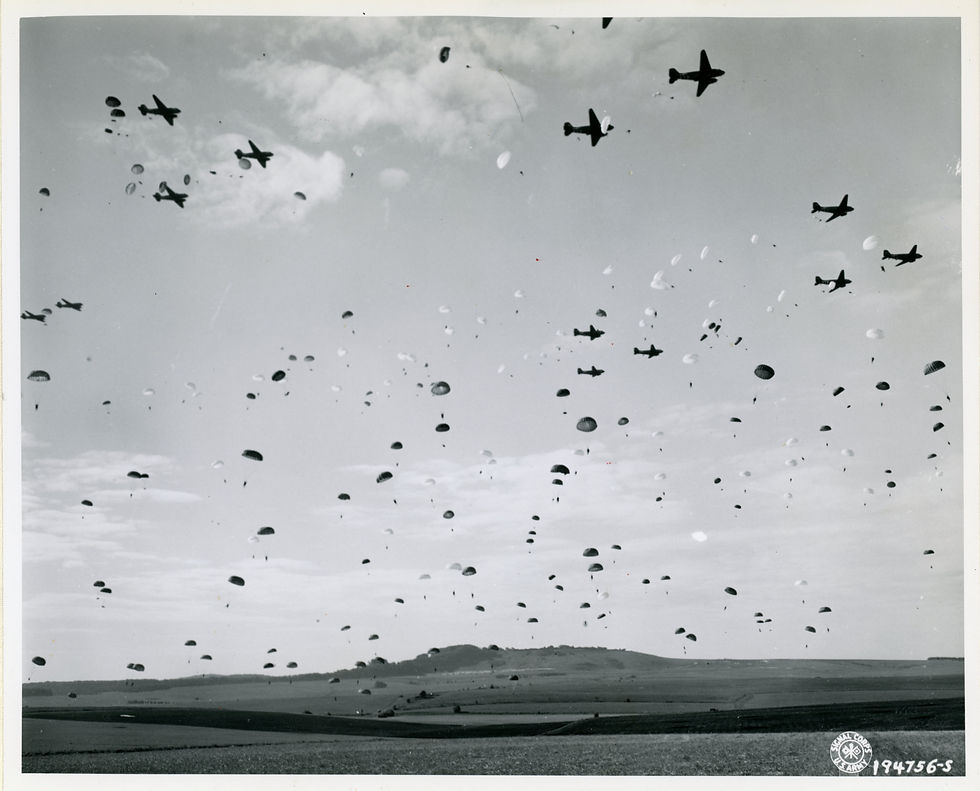
Taken by Rachline: 10/5/44 - Men of the 17th Airborne Division on a practice jump during maneuvers in the ETO.

Taken by Rachline: 11/13/44 - Men recovering at the 15th Army Hospital Center admire the Thanksgiving Day menu.
Taken by Rachline: 11/14/44 - Planes and gliders of the 17th Airborne Division are lined up at Membury Field, Wilts, England, ready for takeoff.
During the ruthless German offensive, photo units were stretched thin and many of the Army’s SPCs weren’t able to fully cover the line from a photographic perspective. As a result, the 3120th hand picked a team of one officer and six enlisted men to send to the front, and they quickly set out to Verdun as a staging area. Many of the selected men had prior experience from their time in SPCs in Normandy or a 3120th detachment sent with airborne divisions in Operation Market Garden. Rachline’s experience with the 17th AB in England earned him a spot in the detachment, but the job marked his first time in combat. The team decided their first coverage would be in the town of Bastogne, Belgium after hearing the news of a German breakthrough and knowing there was a lack of photographers in the area. The town was crucial for supply lines in the German advance, and the team was eager to get plenty of action shots. The photographers met with the 101st Airborne–who also recently arrived in the town–and Leslie quickly learned how to keep his head down in combat from the division who had fought ferociously in Normandy and Market Garden. The photographers from the 3120th began taking pictures of the men trying to stay warm, given the division's undersupply of winter clothes, ammunition, and other supplies. They stayed in town on December 20th, and came to a grave realization upon hearing the news the next day: the 101st, along with the team of photographers, had been completely cut off from the Allies. The Siege of Bastogne began.
In the morning, Leslie and the photographers began thawing their cameras and defrosting their lenses in the freezing cold. They were faced with the fact that, without a chance for a resupply, they were working with a limited supply of film and would have no place to send any of their photos to be developed. On the first day they likely took photos of the 101st AB preparing for the inevitable German attacks while trying to stay warm in their foxholes. The following days, however, heated up with ruthless German artillery and assaults that targeted the town. The photographers, realizing the gravity of the situation they found themselves in, likely tossed their cameras aside to take on more crucial roles in the siege. This could’ve consisted of helping with field hospitals in town, scrounging up supplies, or filling the line as infantrymen. As Lt. Clair Hess of the 501st PIR later recalled about Bastogne, “the films we have just aren’t enough…the cameramen were so busy at the time, banging away with their carbines and their M1s, that they just couldn’t film everything.”

The surviving 3120th Signal Service Battalion photographers upon being rescued from Bastogne. Rachline is sitting, smiling at the camera.

Photographers with the 101st Airborne Division near Bastogne, portrayed in HBO's Band of Brothers (2001).

Destruction and damage in Bastogne from the German siege.
The surviving 3120th Signal Service Battalion photographers upon being rescued from Bastogne. Rachline is sitting, smiling at the camera.
The desperate attacks on the town continued daily through Christmas Eve and Christmas Day, and the Allies attempted to drop supplies from C-47s when the skies were clear enough. Some made it to the 101st, others landed off-target in German territory, but conditions for the troops didn’t seem to improve regardless. The artillery and attacks on the town continued while Leslie and the photographers joined the ranks of the Airborne. On December 26th, members of the 4th Armored Division finally broke through the German lines and made contact with the surrounded troops in Bastogne, then began to establish supply lines and evacuated wounded over the next few days. During the nearly ten-day siege, the 3120th photographers lost two men: one killed and one wounded.
While the remaining members of the team were able to take a couple of days to recuperate and gather more film, they couldn’t stay with the “Battered Bastards of Bastogne” for long. They heard news of Rachline’s old unit, the 17th AB, moving to the front for the first time. In early January the team decided to follow up on the story, and joined them just west of Bastogne. The 17th AB was sent to the area to prevent a second encirclement and was under the assumption that the Germans were in retreat. Instead, they were greeted by a far larger force and heavy artillery. From January 4-7th, Rachline photographed the 513th PIR attempting to hold a narrow, high-rimmed road to the north-west of Bastogne in waist-deep snow and bitter cold. In the thick of the action, Leslie watched the unit’s brutal first days of combat through the viewfinder of his camera–the 17th AB took over 1,000 casualties in just those three days, and nicknamed the road “Dead Man’s Ridge.” The division captured a few towns in the area, but eventually withdrew when they reported roughly 40% casualties in some battalions. Rachline, however, remained on the front and continued taking pictures of other units nearby.


A little over a week later, the photographers joined the 17th AB once again as they moved into Houffalize, Belgium. They followed the division as the Battle of the Bulge was coming to an end, and they pushed remaining Germans out of several small towns. When the 17th AB approached the Siegfried Line in February, they were finally relieved from combat. The photographers took the opportunity to take themselves off the line as well, and returned to Paris. Exhausted from nearly eight weeks of constant frontline duty in brutal fighting and freezing temperatures, Rachline and the team finally rejoined their unit in Paris, now renamed to the 3908th Signal Service Battalion.
For the final months of the war Rachline was sent to photograph various stories in France, such as the liberation of Russian nationals, prisoners accused of war crimes at Loire Disciplinary Training Center, liberated American prisoners of war, troops going on leave in Paris, and overseas mourning from the death of President Franklin D. Roosevelt. Hearing of the official German surrender on May 8th, 1945, Leslie spent the day walking around Paris to photograph various celebrations. At one point he even climbed onto a roof to get a bird’s eye view of an address by General Charles De Gaulle at the Arc de Triomphe. After the initial V-E Day celebrations, Leslie saw a great dropoff in photo work. He found a few stories to follow up on, such as members of congress visiting Europe, as well as President Harry S. Truman landing in Antwerp and meeting with General Dwight D. Eisenhower. Despite occasionally brushing shoulders with the famous figures, the 3908th saw less and less photo work and Rachline was sent back to the states–discharged on December 11th, 1945.

Taken by Rachline: 7/15/45 - President Harry S. Truman speaks with a member of the 137th Regiment, 35th Division (his old outfit from the previous war) as he arrives in Belgium.

Taken by Rachline: 7/15/45 - General Dwight D. Eisenhower chats with President Truman and Secretary of State James F. Byrnes in Belgium.

Taken by Rachline: 3/17/45 - Liberated Russians take charge of their own shoe repair work.
Taken by Rachline: 7/15/45 - President Harry S. Truman speaks with a member of the 137th Regiment, 35th Division (his old outfit from the previous war) as he arrives in Belgium.
Leslie’s time in the Army lasted over three years, and placed him in the sights of an enemy he never expected to see firsthand. He was taken from a lab in London and placed in the middle of some of the fiercest fighting on the Western Front. Needless to say he found new confidence with a camera, and was inspired to pursue a career in photography. Upon returning home he attended New York University and graduated with a degree in Fine Arts, where he met Dorothy, the woman he would marry in 1951. Soon after, he followed his parents to Miami and initially found work with a roofing company while he started a family with his wife.
Rachline quickly made a name for himself, however, and shifted his career to commercial photography. In 1972 he opened a portrait exhibition in Miami, followed by another the next year–with proceeds for the latter going to a local ballet society. Always involved in the local arts, he also found work taking cover photos for classical music albums by Miami musicians in the 1980s. He founded and published two magazines with his wife around the same time: I.D.E.A.S., an all-color interior design publication, and Tekia, a quarterly Jewish magazine. Rachline always carried the skills he learned from his time as a photographer on the brutal battlefields of Belgium, and used it as a launching point for a lifelong career doing what he loved. He continued a life of service and love of the arts until he passed away just before his 70th birthday in 1994.

An article about the publication of Tekiah, one of Leslie and Dorothy's magazines

Supporters at one of Rachline's portrait photography exhibitions

Rachline in his later years
An article about the publication of Tekiah, one of Leslie and Dorothy's magazines